what is toms full name in to kill a mockingbird
There are phrases y'all hear so ofttimes that they begin to lose their meaning. The words become part of a serial, similar "bite the dust" or "have a nail." The title of Harper Lee's 1960 classic To Kill a Mockingbird is like that for me, despite its profound impact on the style I call back nearly the world. The showtime time I read To Kill a Mockingbird was as a student in the 8th grade. Memories are tricky, simply every bit I recall we never talked about the title, or much else, in the book.The most memorable assignment my teacher gave us was to scout the 1962 film version on one of the local television stations. I suppose my teacher believed that watching someone else's vision of the book was safer than having united states of america talk about the issues of race, class, discrimination, and justice it might raise during the heyday of desegregation battles in neighboring Boston. Despite my teacher'due south neglect, To Kill a Mockingbird stuck with me. At starting time I noticed it in small means: Walking habitation from friends' houses in the gloaming I'd pass a yard filled with junk or overgrown grass, and I'd just know that Boo Radley lived there. I had to speed up. As I got older and learned more, different scenes stuck. Scout confronting the lynch mob. Lookout man and Atticus on the porch talking about the upcoming trial. Jem's outrage subsequently the verdict. As a reader, I came to appreciate the dual narrative of Tom Robinson and Boo Radley, and how it lent itself to reflections on both the universal and the item ways we retrieve about race and the "other." One thing, however, connected to elude me: the volume's championship. I've read that To Kill a Mockingbird wasn't Harper Lee'south first choice. Originally she called the book Atticus. I'm happy she didn't stick with that one. I always institute the kids in the book far more than interesting. SparkNotes, an online study site, explains, "The championship of To Kill a Mockingbird has very little literal connection to the plot, merely it carries a dandy deal of symbolic weight in the volume. In this story of innocence destroyed by evil, the 'mockingbird' comes to represent the thought of innocence. Thus, to kill a mockingbird is to destroy innocence." The longest quotation about the book'south championship appears in Chapter ten, when Sentry explains: "'Call up information technology's a sin to kill a mockingbird.' That was the only time I ever heard Atticus say it was a sin to do something, and I asked Miss Maudie about information technology. 'Your begetter's right,' she said. 'Mockingbirds don't practice i matter but make music for u.s. to enjoy…but sing their hearts out for united states of america. That's why it's a sin to kill a mockingbird." So, who is the symbolic mockingbird? Later on in the book, Scout explains to Atticus that hurting their reclusive neighbour Boo Radley would exist "sort of similar shootin' a mockingbird." Mockingbirds are not the only birds in the book. Finch, the terminal name of Scout, Jem, and Atticus, is a small-scale bird. Like mockingbirds, they are also songbirds. Is Tom Robinson, the black homo defendant of sexually assaulting a white woman, a bird as well? While Tom is innocent, I practice not remember of him as having the same innocence as the children or Boo. Every bit a black man in low-era Alabama, I'one thousand certain Tom could teach me quite a bit. Sadly, we don't larn that much about his life beyond the trial. Critics accept said Lee did not give the book's black characters enough agency or backstory. I hope Tom wasn't meant to be the mockingbird Miss Maudie describes to Scout because, consciously or subconsciously, her words evoke quondam blackness minstrel stereotypes depicting African Americans equally happy-go-lucky and singing a song without a care in the world. The Tom I imagine isn't a stereotype. He lives a full life. I wonder what he might tell united states of america that our narrator, young Scout, does not know. When I recall of To Kill a Mockingbird, the bird that comes to mind is not a mockingbird at all. It is the proverbial canary in the coal mine (another 1 of those phrases we don't call back near very much). The treatment of Tom and Boo as they face the spoken and unspoken dictates of Maycomb gives life to the stock paradigm of the canary. These ii canaries expose the fragility of commonwealth when prejudice, myth, and misinformation go unchecked. In the years since its publication, the title "To Kill a Mockingbird" has developed a meaning that goes beyond its internal logic. For many readers, the volume and its characters live with them as intimates. The story offers a reflection point for the moral dilemmas nosotros face up in our own lives. As if to evidence the point, a colleague recently brought me a bumper sticker that makes me smile every fourth dimension I retrieve virtually it. Information technology asks, "What would Scout do?" Transform how y'all teach Harper Lee'southward archetype novel with Facing History'due south multimedia collection, "Teaching Mockingbird."Our report guide and lesson plans will help you employ Mockingbird's setting equally a springboard for engaging students in issues of justice, gender, and race. 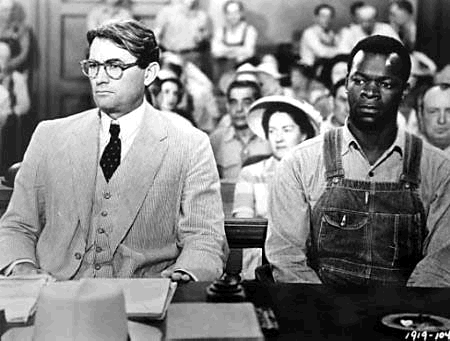 Gregory Peck (left) and Brock Peters in a pivotal scene from the 1962 picture show "To Impale a Mockingbird." Photo courtesy of Wikimedia Commons.

Topics: To Impale a Mockingbird, Classrooms, Books, English language Arts, Facing History Resources, Instruction Resources
Source: https://facingtoday.facinghistory.org/what-does-it-mean-to-kill-a-mockingbird
0 Response to "what is toms full name in to kill a mockingbird"
Post a Comment