Museum of Fine Arts St Pete Vase China 1920
Coordinates: 59°56′26″N 30°18′49″Eastward / 59.94056°N xxx.31361°E / 59.94056; 30.31361
 | |
 View of (from left) the Hermitage Theatre, Old Hermitage, and Small Hermitage | |
 | |
| Established | 1764 |
|---|---|
| Location | 34 Palace Embankment, Dvortsovy Municipal Okrug, Cardinal Commune, Saint Petersburg, Russian federation[2] |
| Collection size | iii million[1] |
| Visitors | 1,649,443 visitors (2021)[three] |
| Director | Mikhail Piotrovsky |
| Public transit access | Admiralteyskaya station |
| Website | hermitagemuseum |
The State Hermitage Museum (Russian: Государственный Эрмитаж , tr. Gosudárstvennyj Ermitáž , IPA: [ɡəsʊˈdarstvʲɪn(ː)ɨj ɪrmʲɪˈtaʂ]) is a museum of fine art and culture in Saint Petersburg, Russian federation. It is the largest art museum in the earth by gallery space.[4] Information technology was founded in 1764 when Empress Catherine the Corking acquired an impressive collection of paintings from the Berlin merchant Johann Ernst Gotzkowsky. The museum celebrates the anniversary of its founding each year on 7 December, Saint Catherine'southward Solar day.[5] It has been open to the public since 1852. In 2021 it ranked 6th in the Listing of most visited fine art museums in the globe, with 1,649,443 visitors.[6]
Its collections, of which only a pocket-sized office is on permanent display, contain over three million items (the numismatic collection accounts for about ane-tertiary of them).[7] The collections occupy a large complex of 6 historic buildings along Palace Embankment, including the Winter Palace, a sometime residence of Russian emperors. Apart from them, the Menshikov Palace, Museum of Porcelain, Storage Facility at Staraya Derevnya, and the eastern wing of the Full general Staff Building are also office of the museum. The museum has several exhibition centers abroad. The Hermitage is a federal country property. Since July 1992, the director of the museum has been Mikhail Piotrovsky.[8]
Of the six buildings in the principal museum complex, v—namely the Winter Palace, Small Hermitage, Old Hermitage, New Hermitage, and Hermitage Theatre—are all open to the public. The archway ticket for strange tourists costs more than than the fee paid by citizens of Russia and Belarus. However, entrance is free of charge the third Th of every month for all visitors, and complimentary daily for students and children. The museum is closed on Mondays. The entrance for private visitors is located in the Winter Palace, attainable from the Courtyard.
Etymology [edit]
A hermitage is the domicile of a hermit or recluse. The discussion derives from Old French hermit, ermit "hermit, recluse", from Tardily Latin eremita, from Greek eremites, that means "people who live solitary", which is in turn derived from ἐρημός (erēmos), "desert". The edifice was initially given this name because of its exclusivity - in its early on days, only very few people were allowed to visit. [ citation needed ]
Buildings [edit]
Originally, the only building housing the collection was the "Modest Hermitage". Today, the Hermitage Museum encompasses many buildings on the Palace Beach and its neighbourhoods. Apart from the Pocket-size Hermitage, the museum at present likewise includes the "Onetime Hermitage" (also called "Large Hermitage"), the "New Hermitage", the "Hermitage Theatre", and the "Winter Palace", the former main residence of the Russian tsars. In recent years, the Hermitage has expanded to the General Staff Building on the Palace Foursquare facing the Winter Palace, and the Menshikov Palace.[9]
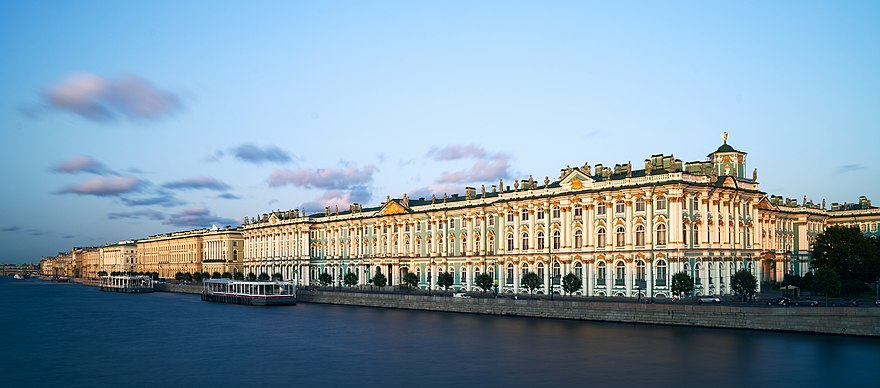
The Hermitage Museum circuitous. From left to right: Hermitage Theatre – Former Hermitage – Small Hermitage – Wintertime Palace (the "New Hermitage" is situated behind the Quondam Hermitage)
Collections [edit]
The Western European Art collection includes European paintings, sculpture, and applied art from the 13th to the 20th centuries. Information technology is displayed, in virtually 120 rooms, on the kickoff and second flooring of the four main buildings. Drawings and prints are displayed in temporary exhibitions.
Egyptian antiquities [edit]

Since 1940, the Egyptian collection, dating back to 1852 and including the former Castiglione Collection, has occupied a big hall on the ground flooring in the eastern function of the Wintertime Palace. It serves as a passage to the exhibition of Classical Antiquities. A modest collection of the culture of Aboriginal Mesopotamia, including a number of Assyrian reliefs from Babylon, Dur-Sharrukin and Nimrud, is located in the same function of the edifice.
Classical antiquities [edit]
The drove of classical antiquities occupies nearly of the ground floor of the Old and New Hermitage buildings. The interiors of the ground floor were designed by German builder Leo von Klenze in the Greek revival style in the early on 1850s, using painted polished stucco and columns of natural marble and granite. One of the largest and near notable interiors of the first floor is the Hall of 20 Columns, divided into three parts past ii rows of grey monolithic columns of Serdobol granite, intended for the display of Graeco-Etruscan vases. Its floor is made of a mod marble mosaic imitating ancient tradition, while the stucco walls and ceiling are covered in painting.
The Room of the Groovy Vase in the western wing features the two.57 m (viii.four ft) high Kolyvan Vase, weighing 19 t (42,000 lb), made of jasper in 1843 and installed before the walls were erected. While the western wing was designed for exhibitions, the rooms on the ground floor in the eastern wing of the New Hermitage, now also hosting exhibitions, were originally intended for libraries. The floor of the Athena Room in the s-eastern corner of the edifice, one of the original libraries, is decorated with an accurate 4th-century mosaic excavated in an early Christian basilica in Chersonesos in 1854.
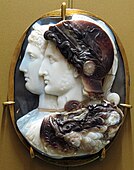
The collection of classical antiquities features Greek artifacts from the third millennium – fifth century BC, ancient Greek pottery, items from the Greek cities of the Due north Pontic Greek colonies, Hellenistic sculpture and jewellery, including engraved gems and cameos, such as the famous Gonzaga Cameo, Italic art from the 9th to second century BC, Roman marble and statuary sculpture and applied fine art from the first century BC - fourth century Advert, including copies of Classical and Hellenistic Greek sculptures. One of the highlights of the drove is the Tauride Venus, which, according to latest research, is an original Hellenistic Greek sculpture rather than a Roman copy equally it was thought earlier.[ten] There are, nonetheless, only a few pieces of authentic Classical Greek sculpture and sepulchral monuments.
Prehistoric art [edit]
On the ground flooring in the western fly of the Wintertime Palace the collections of prehistoric artifacts and the civilization and art of the Caucasus are located, likewise as the second treasure gallery. The prehistoric artifacts date from the Paleolithic to the Iron Historic period and were excavated all over Russia and other parts of the former Soviet Union and Russian Empire. Among them is a renowned collection of the art and culture of nomadic tribes of the Altai from Pazyryk and Bashadar sites, including the world's oldest surviving knotted-pile carpet and a well-preserved wooden chariot, both from the 4th–3rd centuries BC. The Caucasian exhibition includes a collection of Urartu artifacts from Armenia and Western Armenia. Many of them were excavated at Teishebaini under the supervision of Boris Piotrovsky, former director of the Hermitage Museum.
Jewelry and decorative fine art [edit]
Iv small rooms on the ground floor, enclosed in the eye of the New Hermitage between the room displaying Classical Antiquities, incorporate the first treasure gallery, featuring western jewellery from the 4th millennium BC to the early on 20th century Advertising. The second treasure gallery, located on the ground floor in the southwest corner of the Winter Palace, features jewellery from the Pontic steppes, Caucasus and Asia, in particular Scythian and Sarmatian gold. Visitors may only visit the treasure galleries as role of a guided bout.

Pavilion Hall, designed past Andrei Stackenschneider in 1858, occupies the first floor of the Northern Pavilion in the Minor Hermitage. It features the 18th-century gilt Peacock Clock past James Cox and a collection of mosaics. The floor of the hall is adorned with a 19th-century imitation of an aboriginal Roman mosaic.
Two galleries spanning the west side of the Pocket-sized Hermitage from the Northern to Southern Pavilion firm an exhibition of Western European decorative and practical art from the twelfth to 15th century and the fine fine art of the Low Countries from the 15th and 16th centuries.
Italian Renaissance [edit]
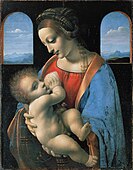
The rooms on the outset flooring of the Old Hermitage were designed by Andrei Stakenschneider in revival styles in between 1851 and 1860, although the design survives simply in some of them. They feature works of Italian Renaissance artists, including Giorgione, Titian, Veronese, likewise as Benois Madonna and Madonna Litta attributed to Leonardo da Vinci or his school.

The Small Italian Skylight Room
The Italian Renaissance galleries continues in the eastern wing of the New Hermitage with paintings, sculpture, majolica and tapestry from Italy of the 15th–16th centuries, including Conestabile Madonna and Madonna with Beardless St. Joseph by Raphael. The gallery known as the Raphael Loggias, designed past Giacomo Quarenghi and painted by Cristopher Unterberger and his workshop in the 1780s as a replication of the loggia in the Apostolic Palace in Rome frescoed by Raphael, runs along the eastern facade.
Italian and Castilian fine art [edit]
The offset floor of New Hermitage contains three large interior spaces in the center of the museum complex with red walls and lit from to a higher place by skylights. These are adorned with 19th-century Russian lapidary works and feature Italian and Castilian canvases of the 16th-18th centuries, including Veronese, Giambattista Pittoni, Tintoretto, Velázquez and Murillo. In the enfilade of smaller rooms alongside the skylight rooms the Italian and Spanish fine art of the 15th-17th centuries, including Michelangelo's Crouching Boy and paintings by El Greco.
The museum also houses paintings by Luis Tristán, Francisco de Zurbarán, Alonso Cano, José de Ribera and Goya.
Knights' Hall [edit]
The Knights' Hall, a large room in the eastern part of the New Hermitage originally designed in the Greek revival fashion for the display of coins, now hosts a collection of Western European artillery and armour from the 15th-17th centuries, office of the Hermitage Armory collection. The Hall of Twelve Columns, in the southeast corner of the New Hermitage, is adorned with columns of grey Serdobol granite and was also designed in the Greek revival mode for the display of coins, is now used for temporary exhibitions.

The Gallery of the History of Ancient Painting adjoins the Knights' Hall and also flanks the skylight rooms. It was designed past Leo von Klenze in the Greek revival style equally a prelude to the museum and features neoclassical marble sculptures by Antonio Canova and his followers. In the centre, the gallery opens to the main staircase of the New Hermitage, which served equally the entrance to the museum before the October Revolution of 1917, but is at present closed. The upper gallery of the staircase is adorned with twenty grey Serdobol granite columns and feature 19th-century European sculpture and Russian lapidary works.
Dutch Golden Age and Flemish Bizarre [edit]

The rooms and galleries forth the southern facade and in the western wing of the New Hermitage are now entirely devoted to Dutch Golden Age and Flemish Baroque painting of the 17th century, including the big collections of Van Dyck, Rubens and Rembrandt. They also contain several paintings past Jan Brueghel the Elder (Velvet period), Frans Snyders (for case, The Fish Market), Gerard ter Borch, Paulus Potter, Jacob van Ruisdael, Jan van Goyen, Ferdinand Bol and Gerard van Honthorst.
German, Swiss, British and French art [edit]
The start floor rooms on the southern facade of the Winter Palace are occupied by the collections of German fine fine art of the 16th century and French fine fine art of the 15th–18th centuries, including paintings past Poussin, Lorrain, Watteau.
The collections of French decorative and applied fine art from the 17th–18th centuries and British applied and fine art from the 16th–19th century, including Thomas Gainsborough and Joshua Reynolds, are on brandish in nearby rooms facing the courtyard. This area also holds paintings by German artists, including Hans Wertinger, Lucas Cranach the Elderberry, Barthel Bruyn the Elder, Caspar David Friedrich (Moonrise by the Sea), Anton Mengs, Hans Thoma, Anselm Feuerbach, Franz Stuck (Two Men Fighting Over a Woman) and Heinrich Campendonk as well as paintings by Swiss painters Angelica Kauffman, Alexandre Calame, Arnold Böcklin and Ferdinand Hodler.
Russian art [edit]
The richly busy interiors of the first floor of the Winter Palace on its eastern, northern and western sides are part of the Russian culture drove and host the exhibitions of Russian art from the 11th-19th centuries. Temporary exhibitions are normally held in the Nicholas Hall.
French Neoclassical, Impressionist, and post-Impressionist art [edit]

Garden at Bordighera, Impression of Morning, 1884, Claude Monet
French Neoclassical, Impressionist and post-Impressionist art, including works by Renoir, Monet, Van Gogh and Gauguin, are displayed on the fourth floor of the Eastern Fly of the General Staff Building. Also displayed are paintings by Camille Pissarro (Boulevard Montmartre, Paris), Paul Cézanne (Mountain Sainte-Victoire), Alfred Sisley, Henri Morel, and Degas.[11] [12]
Modern, German Romantic and other 19–20th century art [edit]

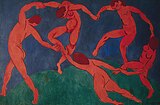
Modern art is displayed in the General Staff Building (Petrograd). It features Matisse, Derain and other fauvists, Picasso, Malevich, Petrocelli, Kandinsky, Giacomo Manzù, Giorgio Morandi and Rockwell Kent. A large room is devoted to the German Romantic fine art of the 19th century, including several paintings by Caspar David Friedrich. The second floor of the Western wing features collections of the Oriental fine art (from China, India, Mongolia, Tibet, Fundamental Asia, Byzantium and Near E).
History [edit]
Origins: Catherine's collection [edit]
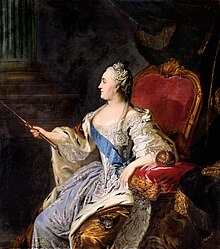
Catherine the Great started her art collection in 1764 by purchasing paintings from Berlin merchant Johann Ernst Gotzkowsky. He assembled the drove for Frederick II of Prussia, who ultimately refused to purchase it. Thus, Gotzkowsky provided 225 or 317 paintings (conflicting accounts list both numbers), mainly Flemish and Dutch, likewise every bit others, including 90 non precisely identified, to the Russian crown.[13] The collection consisted of Rembrandt (13 paintings), Rubens (11 paintings), Jacob Jordaens (7 paintings), Anthony van Dyck (v paintings), Paolo Veronese (5 paintings), Frans Hals (3 paintings, including Portrait of a Beau with a Glove), Raphael (2 paintings), Holbein (two paintings), Titian (1 painting), Jan Steen (The Idlers), Hendrik Goltzius, Dirck van Baburen, Hendrick van Balen and Gerrit van Honthorst.[fourteen] Perchance some of the almost famous and notable artworks that were a part of Catherine's original purchase from Gotzkowsky were Danae, painted past Rembrandt in 1636; Descent from the Cross, painted by Rembrandt in 1624; and Portrait of a Young Human being Belongings a Glove, painted by Frans Hals in 1650. These paintings remain in the Hermitage drove today.[15]
In 1764, Catherine commissioned Yury Felten to build an extension on the east of the Winter Palace which he completed in 1766. Subsequently it became the Southern Pavilion of the Small Hermitage. From 1767 to 1769, French architect Jean-Baptiste Vallin de la Mothe built the Northern Pavilion on the Neva beach. Between 1767 and 1775, the extensions were continued by galleries, where Catherine put her collections.[xvi] The entire neoclassical building is now known as the Minor Hermitage. During the time of Catherine, the Hermitage was not a public museum and few people were immune to view its holdings. Jean-Baptiste Vallin de la Mothe as well rebuilt rooms in the second story of the south-east corner block that was originally congenital for Elizabeth and later occupied by Peter Iii. The largest room in this particular apartment was the Audience Chamber (besides called the Throne Hall) which consisted of 227 square meters.[15]
The Hermitage buildings served as a domicile and workplace for nearly a 1000 people, including the Majestic family. In addition to this, they also served equally an extravagant showplace for all kinds of Russian relics and displays of wealth prior to the art collections. Many events were held in these buildings including masquerades for the nobility, grand receptions and ceremonies for state and authorities officials. The "Hermitage circuitous" was a creation of Catherine's that allowed all kinds of festivities to take place in the palace, the theatre and even the museum of the Hermitage. This helped solidify the Hermitage as non just a dwelling place for the Majestic family, merely too as an important symbol and memorial to the imperial Russian state. Today, the palace and the museum are one and the same. In Catherine's mean solar day, the Winter Palace served as a central part of what was called the Palace Square. The Palace Square served every bit St. Petersburg's nerve center by linking it to all the urban center'south nigh important buildings. The presence of the Palace Foursquare was extremely meaning to the urban development of Petrograd, and while it became less of a nervus center afterwards into the 20th century, its symbolic value was all the same very much preserved.[17]
Catherine acquired the all-time collections offered for sale by the heirs of prominent collectors. In 1769, she purchased Brühl's collection, consisting of over 600 paintings and a vast number of prints and drawings, in Saxony. Three years later, she bought Crozat's collection of paintings in France with the assistance of Denis Diderot. Next, in 1779, she acquired the collection of 198 paintings that once belonged to Robert Walpole in London followed by a collection of 119 paintings in Paris from Count Baudouin in 1781. Catherine'due south favorite items to collect were believed to be engraved gems and cameos. At the inaugural exhibit of the Hermitage, opened past the Prince of Wales in Nov 2000, there was an unabridged gallery devoted to representing and displaying Catherine's favorite items. In this gallery her cameos are displayed along with chiffonier fabricated by David Roentgen, which holds her engraved gems. As the symbol of Minerva was oft used and favored past Catherine to represent her patronage of the arts, a cameo of Catherine as Minerva is as well displayed here. This particular cameo was created for her past her daughter-in-law, the Grand Duchess Maria Fyodorovna. This is merely a small representation of Catherine'southward vast collection of many antiquarian and contemporary engraved gems and cameos.[eighteen]

View of the Palace Embankment by Karl Beggrov, 1826. The Old Hermitage is in the center of the painting.
The collection soon overgrew the building. In her lifetime, Catherine acquired 4,000 paintings from the one-time masters, 38,000 books, ten,000 engraved gems, 10,000 drawings, 16,000 coins and medals and a natural history collection filling two galleries,[19] and so in 1771 she commissioned Yury Felten to build another major extension. The neoclassical edifice was completed in 1787 and has come to exist known as the Big Hermitage or Old Hermitage. Catherine too gave the name of the Hermitage to her individual theatre, congenital nearby between 1783 and 1787 by the Italian builder Giacomo Quarenghi.[20] In London in 1787, Catherine acquired the collection of sculpture that belonged to Lyde Browne, more often than not Ancient Roman marbles. Catherine used them to adorn the Catherine Palace and park in Tsarskoye Selo, only after they became the core of the Classical Antiquities drove of the Hermitage. From 1787 to 1792, Quarenghi designed and built a fly along the Winter Canal with the Raphael Loggias to replicate the loggia in the Apostolic Palace in Rome designed past Donato Bramante and frescoed by Raphael.[16] [21] [22] The loggias in Saint Petersburg were adorned with copies of Vatican frescoes painted by Cristopher Unterberger and his workshop in the 1780s.
Catherine's collection of at to the lowest degree 4,000 paintings came to rival the older and more than prestigious museums of Western Europe. Catherine took great pride in her collection and actively participated in extensive competitive art gathering and collecting that was prevalent in European royal courtroom culture. Through her art collection she gained European acknowledgment and acceptance and portrayed Russia as an enlightened lodge. Catherine went on to invest much of her identity in being a patron of the arts. She was especially fond of the Roman deity Minerva, whose characteristics according to classical tradition are armed forces prowess, wisdom, and patronage of the arts. Using the title Catherine the Minerva, she created new institutions of literature and civilisation and also participated in many projects of her own, generally play writing. The representation of Catherine alongside Minerva would come to be a tradition of enlightened patronage in Russia.[23]
Expansion in the 19th century [edit]
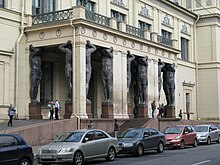
Portico with atlantes, historical archway
In 1815, Alexander I of Russia purchased 38 pictures from the heirs of Joséphine de Beauharnais, virtually of which had been looted by the French in Kassel during the state of war. The Hermitage collection of Rembrandts was then considered the largest in the world. Also among Alexander's purchases from Josephine's estate were the first four sculptures by the neoclassical Italian sculptor Antonio Canova to enter the Hermitage collection.
Somewhen the imperial collections were enriched by Greek and Scythian artifacts excavated within the Russian Empire.

Between 1840 and 1843, Vasily Stasov redesigned the interiors of the Southern Pavilion of the Small Hermitage. In 1838, Nicholas I deputed the neoclassical German architect Leo von Klenze to design a building for the public museum. Space for the museum was made next to the Small Hermitage by the sabotage of the Shepelev Palace and royal stables. The construction was overseen past the Russian architects Vasily Stasov and Nikolai Yefimov from 1842 to 1851 and incorporated Quarenghi'south wing with the Raphael Loggias.
In 1851, in Venice the museum acquired the collection of Cristoforo Barbarigo, including five more canvases by Titian. Today, all of the paintings but i (Danaë) by Titian in the Hermitage Museum came to St. Petersburg from the Barbarigo collection.
The New Hermitage was opened to the public on 5 February 1852.[24] In the same yr the Egyptian Drove of the Hermitage Museum emerged and was especially enriched by items given by the Knuckles of Leuchtenberg, Nicholas I'due south son-in-constabulary. Meanwhile, from 1851 to 1860, the interiors of the Onetime Hermitage were redesigned by Andrei Stackensneider to accommodate the State Associates, Cabinet of Ministers and country apartments. Stakenschneider created the Pavilion Hall in the Northern Pavilion of the Small Hermitage from 1851 to 1858.[16]
Until the 1920s, the museum's archway was under the portico supported by five-metre high atlantes of grey Serdobol granite from Finland in the middle of the southern facade of the New Hermitage building.
In 1861, the Hermitage purchased from the Papal government function of the Giampietro Campana drove, which consisted mostly classical antiquities. These included over 500 vases, 200 bronzes and a number of marble statues. The Hermitage acquired Madonna Litta, which was then attributed to Leonardo, in 1865, and Raphael's Connestabile Madonna in 1870. In 1884 in Paris, Alexander 3 of Russia acquired the collection of Alexander Basilewski, featuring European medieval and Renaissance artifacts. In 1885, the Arsenal collection of arms and armour, founded by Alexander I of Russia, was transferred from the Catherine Palace in Tsarskoye Selo to the Hermitage. In 1914, Leonardo'south Benois Madonna was added to the drove.
Later on the October Revolution [edit]
Immediately later on the Revolution of 1917 the Royal Hermitage and the Winter Palace, the erstwhile Imperial residence, were proclaimed state museums and eventually merged.

A room in the Winter Palace
The range of the Hermitage's exhibits was further expanded when individual fine art collections from several palaces of the Russian Tsars and numerous private mansions were nationalized and redistributed among major Soviet state museums. Specially notable was the influx of one-time masters from the Catherine Palace, the Alexander Palace, the Stroganov Palace and the Yusupov Palace every bit well as from other palaces of Saint Petersburg and suburbs.
In 1922, an important collection of 19th-century European paintings was transferred to the Hermitage from the Academy of Arts. In plow, in 1927 about 500 important paintings were transferred to the Central Museum of quondam Western fine art in Moscow at the insistence of the Soviet authorities. In the early 1930s, lxx more paintings were sent there. Later 1932, a number of less significant works of art were transferred to new museums all over the Soviet Union.
In 1928, the Soviet government ordered the Hermitage to compile a list of valuable works of art for export. From 1930 to 1934, over two thousand works of art from the Hermitage collection were sold at auctions abroad or directly to foreign officials and businesspeople[ citation needed ]. The sold items included Raphael's Alba Madonna, Titian's Venus with a Mirror, and Jan van Eyck'south Annunciation, among other world known masterpieces by Botticelli, Rembrandt, Van Dyck, and others. In 1931, after a series of negotiations, Andrew W. Mellon acquired 21 works of art from the Hermitage and later donated them to class a nucleus of the National Gallery of Fine art in Washington, D.C. (see also Soviet sale of Hermitage paintings).

Soviet ski troops by the portico during the Siege of Leningrad
With the German invasion of the Soviet Union in 1941, before the Siege of Leningrad started, ii trains with a considerable part of the collections were evacuated to Sverdlovsk. 2 bombs and a number of shells striking the museum buildings during the siege. The museum opened an exhibition in November 1944. In Oct 1945 the evacuated collections were brought back, and in Nov 1945 the museum reopened.
In 1948, 316 works of Impressionist, post-Impressionist, and modern art from the collection of the Museum of New Western Art in Moscow, originating mostly from the nationalized collections of Sergei Shchukin and Ivan Morozov and disestablished[ clarification needed ] before the war, were transferred to the Hermitage, including works by Matisse and Picasso. Beginning in 1967, a number of works by Matisse were donated to the museum by his muse Lydia Delectorskaya.
In 1981, the restored Menshikov Palace became a new branch of the Hermitage museum, displaying Russian civilization of the early 18th century.
On 15 June 1985, a man afterwards judged insane attacked Rembrandt'due south painting Danaë, displayed in the museum. He threw sulfuric acid on the canvas and cut it twice with a knife. The restoration of the painting had been accomplished by Hermitage conservationists by 1997, and Danaë is now on display behind armoured glass.
The Hermitage since 1991 [edit]
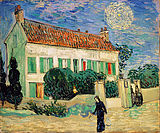
In 1991, information technology became known that some paintings looted by the Red Ground forces in Frg in 1945 were held in the Hermitage. But only in October 1994 did the Hermitage officially announce that it had secretly been holding a major trove of French Impressionist and Post-Impressionist paintings from German individual collections. The exhibition "Hidden Treasures Revealed", where 74 of the paintings were displayed for the first time, was opened on 30 March 1995 in the Nicholas Hall of the Winter Palace and lasted a year. Of the paintings, all but one originated from individual rather than state German language collections, including 56 paintings from the Otto Krebs collection, as well as the collection of Bernhard Koehler and paintings previously belonging to Otto Gerstenberg and his daughter Margarete Scharf, including the world-famous Identify de la Concorde by Degas, In the Garden by Renoir, and White House at Nighttime by Van Gogh.[25] [26] [27] Some of the paintings are at present on permanent display in several small rooms in the northeastern corner of the Winter Palace on the first floor.[28] [29]
In 1993, the Russian government gave the eastern wing of the nearby General Staff Building across the Palace Square to the Hermitage and the new exhibition rooms in 1999. Since 2003, the Great Courtyard of the Winter Palace has been open up to the public providing some other entrance to the museum. Also in 2003, the Museum of Porcelain opened equally a part of the Hermitage on the grounds of the Majestic Porcelain Factory.
In Dec 2001, the Hermitage was the setting for Russian Ark, a motion picture by Russian managing director Aleksandr Sokurov, in which he elaboratively chronicles 300 years of the history of the building and the city in one uninterrupted, single-take shot, a start in world movie theater.
In 2003, the Hermitage loaned 142 pieces to the Academy of Michigan Museum of Art for an exhibition titled The Romanovs Collect: European Art from the Hermitage.[30]
In December 2004, the museum discovered another looted work of art: Venus Disarming Mars past Rubens was once in the collection of the Rheinsberg Palace about Berlin, and was apparently looted by Soviet troops from the Königsberg Castle in Eastward Prussia in 1945. At the time, Mikhail Piotrovsky said the painting would exist cleaned and displayed.[31]
The museum appear in July 2006 that 221 minor items, including jewelry, Orthodox icons, silverware and richly enameled objects, had been stolen. The value of the stolen items was estimated to exist approximately $543,000. Past the end of 2006 several of the stolen items had been recovered.[32]
In March 2020, Apple tree released a continuous v hr and 19 minute one shot moving-picture show recorded entirely on an iPhone 11 Pro detailing many rooms of the museum which highlighted not simply the artwork, but also the compages, and live movement pieces interspersed throughout.[33]
Dependencies [edit]

Deer golden plaque from Krasnodar, commencement of sixth century BC
In recent years, the Hermitage launched several dependencies away and domestically.
Hermitage Amsterdam [edit]
The dependency of the Hermitage Museum in Amsterdam is known as the Hermitage Amsterdam, and is located in the erstwhile Amstelhof building. Information technology opened on 24 February 2004 in a modest edifice on the Nieuwe Herengracht in Amsterdam, awaiting the closing of the retirement home which withal occupied the Amstelhof building until 2007. Between 2007 and 2009, the Amstelhof was renovated and made suitable for the housing of the Amsterdam Hermitage. The Amsterdam Hermitage was opened on 19 June 2009 by President Dmitry Medvedev and Queen Beatrix of kingdom of the netherlands.[34]
Hermitage-Kazan Exhibition Center [edit]
The Hermitage dependency in Kazan (Tatarstan, Russia), opened in 2005. It was created with back up from President of the Commonwealth of Tatarstan Mintimer Shaimiev and is a subdivision of the Kazan Kremlin Country Historical and Architectural Museum-Park. The museum is situated in the Kazan Kremlin in an edifice previously occupied past the Junker School built in the showtime of the 19th century.[35]
Ermitage Italia, Ferrara [edit]
Following the prior experiences in London, Las Vegas, Amsterdam and Kazan, the Hermitage foundation decided to create a further branch in Italy with the launch of a national bid. Several northern Italian cities expressed interest such every bit Verona, Mantua, Ferrara and Turin. In 2007, the accolade was awarded to the city of Ferrara which proposed its Castle Estense equally the base of operations. Since and so, the new establishment chosen Ermitage Italia started a research and scientific collaboration with the Hermitage foundation.[36]
Hermitage-Vyborg Middle [edit]
Hermitage-Vyborg Eye was opened in June 2010 in Vyborg, Leningrad Oblast.
Hermitage Exhibition Center, Vladivostok [edit]
A Hermitage branch is due to open in Vladivostok past 2016, and the regional government has allocated more than Rb17.seven million ($558,000) for preliminary reconstruction work on a mansion in Vladivostok's historic downtown district to house the satellite.[37]
Hermitage-Siberia, Omsk [edit]
The Hermitage-Siberia is due to open up in Omsk in 2016.[37]
Guggenheim Hermitage Museum, Vilnius [edit]
In recent years, there take been proposals to open up a Vilnius Guggenheim Hermitage Museum in the capital city of Republic of lithuania. Like the quondam Las Vegas dependency, the museum is to combine artworks from the Leningrad Hermitage with works from the New York Guggenheim Museum.[38]
Erstwhile dependencies [edit]
The Guggenheim Hermitage Museum in Las Vegas opened on 7 October 2001 and closed on 11 May 2008.[39] The Hermitage Rooms in London'southward Somerset Firm opened on 25 November 2000.[40] The exhibition was closed permanently in Nov 2007 due to poor visitor numbers.[41]
Direction [edit]
Hermitage directors [edit]
- Florian Gilles
- Stepan Gedeonov (1863–78)
- Alexander Vasilchikov (1879–88)
- Sergei Nikitich Trubetskoi (1888–99)
- Ivan Vsevolozhsky (1899–1909)
- Dmitry Tolstoi (1909–1918)
- Boris Legran (1931–1934)
- Iosif Orbeli (1934–1951)
- Mikhail Artamonov (1951–1964)
- Boris Piotrovsky (1964–1990)
- Mikhail Piotrovsky (1992–present)
Volunteer service [edit]
The Hermitage Volunteer Service offers all those interested a unique opportunity to involve themselves in running this world-renowned museum. The program non only aids the Hermitage with its external and internal activities but also serves as an informal link between the museum staff and the public, bringing the specific knowledge of the museum'southward experts to the customs. Volunteers may likewise develop projects reflecting their ain personal goals and interests: communicate a feeling of responsibility to the youth so as to help them understand the value of tradition and the necessity of its preservation.
Cats [edit]
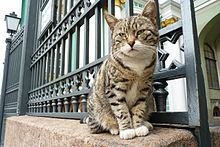
A population of cats lives on the museum grounds and serves as an attraction.[42]
In popular culture [edit]
Films [edit]
- Russian Ark (2002), the Russian film by Alexander Sokurov, was filmed entirely in the Hermitage Museum, showing the Winter Palace at various stages of its history.
- State of war and Peace (1966–67), an Oscar-winning Soviet adaptation of the 1869 novel by Leo Tolstoy, was partially filmed in the Winter Palace.
Television [edit]
Russian federation-Grand, a Russian national television channel, has been presenting the various fine art collections of the Hermitage to the general public for years. There are a series of programs that have aired entitled 'My Hermitage' that have been especially successful. All of these programs are organized past the Director of the Hermitage, Professor Mikhail Piotrovsky, and are quite like to the broadcasts created by Academician Boris Piotrovsky, who is Mikhail's father. These programs were first broadcast through the Soviet Union's 'First' channel, airing at the height of the museum's nail. During this time, this channel recorded more three million visitors every yr, mostly from the Soviet Union. Another program created by the Hermitage was chosen 'The Treasures of Petrograd,' and was broadcast on the Leningrad regional tv set. This plan gave insight into what exhibitions were being displayed at the Hermitage.[43]
Treasures of St Petersburg & The Hermitage, (2003) a iii-office documentary series for Aqueduct 5 in the U.k., directed by Graham Addicott and produced by Pille Runk.
'Hermitage Revealed' (2014) is a BBC documentary from Margy Kinmonth. The film tells the story of its journey from imperial palace to state museum, investigating remarkable tales of dedication, devotion, ownership and ultimate sacrifice, showing how the collection came about, how it survived tumultuous revolutionary times and what makes the Hermitage unique today.[44]
Literature [edit]
- To the Hermitage, a 2000 novel by Malcolm Bradbury, retells the story of Diderot's journeying to Russia to meet Catherine the Great in her Hermitage.
- Petersburg, a 1913 novel by Andrey Bely, features the Winter Canal near the palace equally i of its key locations, simply never names the Winter Palace direct.
- Ghostwritten, by David Mitchell, features as 1 of its protagonists a woman who works for an art counterfeiting band whilst masquerading every bit a docent in a gallery room on the upper floor of the Large Hermitage.
- The Madonnas of Petrograd, a novel by Debra Dean, features the Hermitage during World War II.
- Sancar Seckiner'south 2017 book Thilda's House (Thilda'nın Evi) includes a chapter highlighting the writer'southward experience at the Hermitage Museum past indicating several masterworks of the 15th–19th centuries. ISBN 978-605-4160-88-4
Games [edit]
- The Hermitage appears in the video games Civilization Iv, Civilization V and Civilisation VI equally a wonder of the world.[45]
- The Hermitage appears in the kickoff mission of the Soviet campaign in the video game Command and Conquer: Red Warning three; it is under attack from forces of the Empire of the Rising Sun.
Gallery [edit]
-

-
-

-

-
-

-

-

-

-

-

-

-

-
-

Post-Impressionism: The Overture to Tannhauser: The Artist's Female parent and Sister by Paul Cézanne (1868)
-

-
See also [edit]
- List of most visited art museums
- List of museums in Leningrad
- Baldin Drove
Notes [edit]
- ^ "Hermitage in Figures and Facts". Hermitagemuseum.org . Retrieved 30 June 2020.
- ^ "About the State Hermitage Museum". Hermitagemuseum.org . Retrieved 12 Jan 2021.
- ^ The Fine art Newspaper annual survey, March 28,2022
- ^ "Hermitage in Figures and Facts". Country Hermitage Museum . Retrieved 3 August 2021.
- ^ Folio 7
- ^ The Art Newspaper almanac survey, March 28,2022
- ^ Page 20
- ^ "Mikhail Piotrovsky". The State Hermitage Museum . Retrieved nineteen June 2016.
- ^ "Государственный Эрмитаж" [The Country hermitage Museum] (in Russian). Culture.ru. Retrieved 9 Feb 2020.
- ^ "Traditional Meeting with Journalists: Farewell to White Nights - 2005". www.hermitagemuseum.org. Archived from the original on 17 February 2012.
- ^ "The Room of French Painting of the Second Half of the 19th Century (Daumier, Manet, Degas)". Hermitage Museum.
- ^ "Claude Monet Room".
- ^ Norman 1997, pp. 28–29
- ^ Frank 2002
- ^ a b "Hermitage History," www.hermitagemuseum.org.[ full citation needed ]
- ^ a b c Saint Petersburg Encyclopedia - Hermitage Buildings (entry)
- ^ Piotrovsky, Mikhail, "The Hermitage in the Context of the Metropolis," Museum International 55, no. ane, 79–eighty.
- ^ Mason, Mary Willan, "The Treasures of Catherine the Keen from the State Hermitage Museum St. Petersburg," Antiques & Collecting Magazine 106, no. 3, 62.
- ^ Norman 1997, p. 23
- ^ Norman 1997, pp. 37–38
- ^ "Hermitage History: The Raphael Loggias". www.hermitagemuseum.org. Archived from the original on 11 September 2012. Retrieved 7 September 2012.
- ^ "Hermitage History: Timeline: 1771–1787: Structure of the Great Hermitage". www.hermitagemuseum.org. Archived from the original on 28 June 2012. Retrieved 7 September 2012.
- ^ Dianina, Katia, "Art and Authorization: The Hermitage of Catherine the Cracking," Russian Review 63, no. 4, 634–636.
- ^ Norman 1997, p. 1
- ^ John Russell (4 October 1994). "Hermitage Reveals It Hid Trove of Impressionist Art". The New York Times . Retrieved 25 February 2014.
- ^ Steven Erlanger (thirty March 1995). "Restitution Hermitage, in Its Manner, Displays Its Looted Art". The New York Times.
- ^ "Hermitage History: Timeline: 1995: The exhibition Hidden Treasures Revealed". www.hermitagemuseum.org. Archived from the original on 3 March 2014.
- ^ "Virtual Tour: 70: Room Displaying "Unknown Masterpieces"". www.hermitagemuseum.org. Archived from the original on nine February 2014.
- ^ "Virtual Tour: 71: Room Displaying "Unknown Masterpieces"". www.hermitagemuseum.org. Archived from the original on five October 2013.
- ^ "News | Museum of Art (UMMA) | U-Thousand". umma.umich.edu . Retrieved 25 September 2020.
- ^ John Varoli (20 December 2004). "St Petersburg: Rubens looted from Frg discovered at Hermitage". The Art Paper. Codart.nl. Retrieved 29 November 2012.
- ^ Galina Stolyarova (ane August 2006). "Stolen Russian Museum Items Not Insured". The Washington Post . Retrieved 29 November 2012.
- ^ Archived at Ghostarchive and the Wayback Motorcar: "A one-take journey through Russian federation's iconic Hermitage museum | Shot on iPhone 11 Pro". YouTube.
- ^ Reuters.com - Russian federation's Hermitage museum opens Amsterdam co-operative
- ^ "The Hermitage-Kazan Exhibition Center, Tatarstan". www.hermitagemuseum.org. Archived from the original on viii August 2014.
- ^ "ErmitageItalia Homepage". Ermitageitalia.com. Archived from the original on sixteen March 2012. Retrieved vii September 2012.
- ^ a b Sophia Kishkovsky (6 November 2013), Launch (museum) satellites, says Putin Archived 7 Nov 2013 at the Wayback Auto The Art Paper.
- ^ Ben Sisario (12 June 2008). "ARTS, BRIEFLY; Lithuania Approves Guggenheim Project". The New York Times . Retrieved 30 May 2012.
- ^ "Guggenheim Hermitage Museum in Las Vegas concludes seven-year residency at the Venetian Hotel-Resort-Casino" (Press release). Guggenheim Foundation. 9 April 2008. Archived from the original on four Jan 2013. Retrieved 29 November 2012.
- ^ "The Hermitage Rooms in Somerset House, London". world wide web.hermitagemuseum.org. Archived from the original on eight August 2014.
- ^ Philippa Stockley (30 October 2007). "Josephine's bye from the Hermitage". The Evening Standard. standard.co.uk. Retrieved 29 Nov 2012.
- ^ Cole, Teresa Levonian (5 Feb 2016). "St Petersburg: the cats of the Hermitage". The Telegraph. ISSN 0307-1235. Retrieved 6 March 2018.
- ^ Matveev, Vladimir, "The Hermitage and its Links with Regions of Russia," Museum International 55, no. i, 68.
- ^ "Hermitage Revealed". IMDb.
- ^ "Civilization Fanatics' Forums - View Single Post - Civ5 Confirmed Features and Versions". Forums.civfanatics.com. Retrieved vii September 2012.
References [edit]
| External video | |
|---|---|
 Presentation by Geraldine Norman on The Hermitage: The Biography of a Great Museum, April 2, 1998, C-Bridge Presentation by Geraldine Norman on The Hermitage: The Biography of a Great Museum, April 2, 1998, C-Bridge |
- Frank, Christoph (2002), "Die Gemäldesammlungen Gotzkowsky, Eimbke und Stein: Zur Berliner Sammlungsgeschichte während des Siebenjährigen Krieges.", in Michael North (ed.), Kunstsammeln und Geschmack im 18. Jahrhundert (in German), Berlin: Berlin Verlag Spitz, pp. 117–194, ISBN3-8305-0312-1
- Norman, Geraldine (1997), The Hermitage; The Biography of a Nifty Museum , New York: Fromm International, ISBN0-88064-190-8
Further reading [edit]
- Dutch and Flemish paintings from the Hermitage . New York: The Metropolitan Museum of Fine art. 1988.
External links [edit]
- Official website
- Hermitage Museum Unofficial Guide
- Hermitage Amsterdam
-
 Geographic information related to Hermitage Museum at OpenStreetMap
Source: https://en.wikipedia.org/wiki/Hermitage_Museum
0 Response to "Museum of Fine Arts St Pete Vase China 1920"
Post a Comment